Tuesday, 4 June 2013

What are we doing in Sea Turtles in June?

It’s gardening in Sea Turtles this month. Developing the sensory garden last month has been so much fun and the children have loved play gardening and watching the planting of seeds and small plants. So let the good weather bring on some green fingers!

 The activities this month will be based around the Early Years Foundation Stage (EYFS) areas of learning:

Prime areas:
PSED: Engaging others to achieve a common goal such as working together to get items out of reach.  PD: Making connections between their physical actions and the effects they can make. C&L Gesturing, facial expressions, demonstrations of emotion in sharing an interest.

Specific areas:
M: Recognising big things and small things in meaningful contexts. UW: Exploring objects by linking different approaches; shaking, hitting, looking, feeling, tasting, mouthing, etc. EA&D Imitating and improving actions they have observed, such as chapping, shaking, patting hands.

Some of the activities we will be doing this month will involve:

·         Gardening. Continuing to develop our gardening boxes with the children and sharing with them the process.

·         Cress growing with Ella to make grassy areas and green fields for the small world play environments.

·         Planting sunflower seeds with Laura. Watching them sprout and grow.

·         Finding flowers and learning names with Cristina. Collages out of magazine cuttings and flower spotting in books and magazines.

·         Role playing gardening flowers and seeds with Sarah. Using a range of tools to act out gardening.

·         Looking at images of insects and creating insect collages with Sarah.

·         Taking an excursion to Kew Gardens to look at flowers and the growing environment.

·         Visiting Dolphins gardening work to see what they have been doing.

Some ideas to support your children at home:

·         If you have a Kew membership, know someone with an allotment or garden, take an extra visit. Find a gardener and just take some time out to watch them gardening. Talk about what they are doing.

·         Invest in a children’s watering can. Small toddlers love watering gardens, window boxes, etc. If you have nothing for them to water, fill up a can and go for a walk down the street to water someone else’s plants. Weeds are good for watering too!

·         Do you have a small patch in your garden that you could give up for your little one to develop their green fingers and do some digging? Or, how about a tray you could put some soil or sand in, add some weeds, small seeds, sand and let them loose with a children’s gardening set.

·         Read some books together with a gardening topic. Let them point, communicate with gesture and share what they have been doing at nursery with you.

·         Language: dig, push, pull, turn, scratch, soft, hard, sharp, spikey, flat, bumpy, pour, tip, drizzle, drip, slosh, splash, splatter, any great descriptive words that explain what you are doing.

 
What are we doing in Dolphins in June?

Exploring growing and changes in animals has moved into growing and changing in the environment in general. So many changes this last month with the leaves, flowers and everything happening all at once. We usually explore growing plants for food and pleasure well before June, but this year, our everlasting winter has pushed it right to June!

The activities this month will be based around the Early Years Foundation Stage (EYFS) areas of learning:
Prime areas:
PSED: Working together as a group to develop our window boxes and pots. Gaining a sense of contribution. PD: Learning how to use and manipulate gardening tools. C&L Learning new words to describe change and growth and also the names of the different tools, containers and items we are using to support the gardening. Also names of plants and the stages in their lifecycle.

Specific areas:
L: Introducing a variety of fiction and non-fiction stories on growing. Looking at text as a way of labelling the different parts of plants. M: Looking at shapes in the natural environment. Thinking about the ‘time’ it takes for growth and lifecycles. Measuring- how long, short, tall, wide, the plants are. EA&D: Experimenting with a variety of ways to create interesting and vibrant mages of spring.

Some of the activities we will be doing this month to support this will be:
·         Flower printing. Manjit will be supporting the children to make images of flowers using the end of bottles as prints.

·         Cress growing. Christine H will be working with the children on growing cress and using it to then make cress sandwiches to try for tea.

·         Sunflower pot decorating. Marie Claire will be working with the children to decorate their own pots to grow sunflowers in. She will then work with the children on tracking their growth.

·         Piñata. Laura Z will be making a piñata with the children in the shape of a flower. Once finished they will knock it open for the flower seeds to spill out for them to plant.

·         Pop up flowers. Matt will be working with the children on making pop up flowers for the children to pretend to water and grow.

·         Grass heads. Jenny will be making grass heads with the pre-schoolers. Measuring how fast they grow, comparing growth, etc.

·         Shopping for plants, seeds and equipment. Jenny and Manjit will be taking some children on excursions to Homebase to buy seeds, plants and items for gardening.

·         Plant prints. Shilpi will work with the children to examine different parts of the plant and then taking prints from them.

What you could do to support your children at home:

·       Share with the nursery any gardening your children do at home. Send us your pictures for children to talk about together and for us to display.

·       Bring in your seedlings. If you have any seedlings you have too many of, let your child bring them into nursery to contribute to our garden.

·       Share books, research on the internet, take note in the environment, spend time talking about all changes that take place through growth.

·       Use language they can manage and use to describe the different parts of plants; roots, stem, leaves, seed, seed head, seed pod, petals, flowers, buds.

·       Use language to describe the changes the plants are making; growing, getting longer, bigger, bushier, fuller, changing colour, bursting, flowering, opening, etc.

Monday, 3 June 2013

Sea Turtles sensory fun times!


Sea Turtles in May and June- Messy, sensory play!
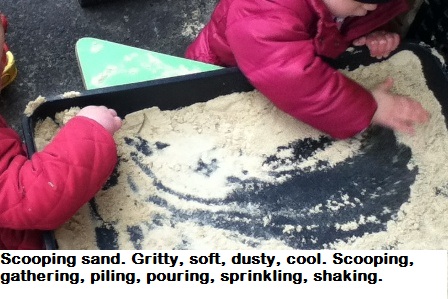
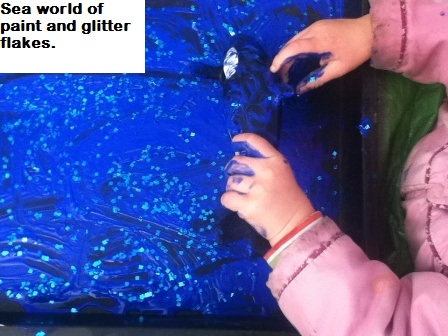
Sea Turtles have had an incredibly messy couple of months. There is nothing new in sensory play at the nursery, but they have had an enhanced focus and really pulled out a lot of fun. Some, but not all of it is recorded in the gallery below. It is very hard to do a photo shoot when you are elbow deep in wet stuff! And if you are wondering why on earth messy play is so good for children’s learning, read on…

Gloopy, slippery, fragrant, sticky, oozey...that's what sensory play is all about! Learning, memory and retention improve depending upon how many of our senses are engaged. Many of our favourite memories involve multiple senses. The best way to think about how important our sensory experiences are in engaging memory are to think about how certain smells remind us of an event, experience or activity from really early in our childhood and then a whole range of memories build from that as that is how the learning took place too.
Further, sensory experiences provide loads of opportunities for:

Language Development
For children to appreciate and fully utilize their language skills, they must have experiences interesting enough to talk about. Sensory experiences are exciting because children can use the materials differently. Children also develop pre-writing skills as they pour, spoon, grasp, and work on eye-hand coordination tasks as they use the materials.
Personal, Social and Emotional Development
Sensory experiences provide children with the opportunity to feel good about their decision-making skills - they control their actions and the experience. Children learn to take some risks and try things that they may have reservations about. It supports an exploratory impulse- essential in developing an eagerness to learn.


In addition, children learn to cooperate and work together around the sensory table. As the children work together or side-by-side, they learn to understand and predict someone else’s actions. The children also have the opportunity to express themselves and become confident in sharing their experiences with others. Children need an opportunity to try out their emerging concepts about their world in a safe environment as well as have appropriate outlets for relieving tension. Pounding, squishing, feeling water through their hands are all ways of staying in contact with feelings while learning to control what they do about them.
Physical Development
Children reinforce and practice their small motor skills while pouring, measuring, stirring, whisking, and manipulating the materials. They learn to control their bodies and give their bodies directions to accomplish tasks as they explore. Gross motor skills are refined as children explore, usually outside, with running through water, examining surfaces with hands and feet, or foot painting.


Creative Development
Sensory experiences provide open-ended opportunities where the process is more important than the product - how children use the materials is much more important than what they make with them. Using creative thinking skills and expressing one's creativity are important self-esteem builders.
Maths concepts.
Learning about size, conservation, counting, timing (how long it takes the sand to sift versus. the dirt), matching (finding the same size or shape shells or stones), and classifying and sorting (what are colour, texture, item types). As children manipulate the materials, they learn to understand concepts such as more/less, full/empty and sink/float.

Science concepts
Learning about cause and effect (what happens when water is added to dirt), gravity (water comes down the funnel not up), and solid to liquid (cornmeal and water mixture) are also explored.

Here is some of how we have explored.....


Animals and Lifecycles in Dolphins.

Dolphins have been discovering and learning about animals and lifecycles- there is so much to learn and it has been so interesting and fun.

Here is a little bit on how animals are an amazing way to learn a range of skills and some of the activities we have been doing.

Knowledge and understanding
Children love to discover more about animals, where and how they live and the things they need. The links and contacts with the rest of the world and environment are immense. Cause and effect, lifecycles, growing provide endless opportunities of questions, discovery, prediction, linking knowledge to build a bigger picture.

The incredible richness and diversity of the animal kingdom makes it fascinating for young minds to explore. Creatures of all shapes, colours and sizes are all around us and provoke questions and thought. Why do some animals fly and others swim? Who eats who? Where do they live? Do fish sleep?

Animals inspire a natural desire to learn and acquire knowledge, and to have that knowledge tested. They also hold a fascination that begins in childhood and stays with us throughout our lives. In some ways they are so much like us, and in others they are totally different.

Communication, Language and Literacy
Finding out more about animals encourages children to have fun with words and pictures, by describing and questioning.

Children love seeing how animals behave and this includes hearing the sounds they make. The simplicity of a 'moo', 'quack' or 'woof' makes them easy for children to mimic. This in turn represents an early opportunity for imaginative role play games.

The act of stroking a rabbit, or watching the penguins being fed at the zoo, involves non-verbal communication and emotional responses that strike a chord with children and help them to learn about different ways of interacting.

Personal Social and Emotional development
Understanding and caring about other living things helps children to find out more about themselves.

Children quickly learn that animals are living beings and, as such, share many of our own characteristics. Children especially relate to small animals that, like them, need to be looked after and cared for. By imagining animals to have human feelings of happiness and sadness, children may learn to be kind and to treat others with care and respect, which helps them to build their confidence and self-esteem.

Making connections between their own lives and actions and those of the animals that surround them is both fascinating and reassuring for children as they make sense of their world.

Physical development
Looking at the way animals move helps children to learn little movements like writing and drawing.

Which is more fun? 'Jump!' or 'Bounce like a kangaroo!'? 'Run' or 'Run as fast as a cheetah!'? Mimicking animal movements is imaginative and fun, providing an ideal stimulus for varied physical exercise and development. Children can also learn how to be gentle with insects and small animals, to move slowly so as not to scare timid creatures, as well as stroking, patting, holding, cupping hands for feeding, and tickling.

And, there is all of the gross motor skill development of role playing animals; stomping like an elephant, scratching like a chimp, crawling like a spider.

Maths
Sorting, ordering, seriating, sequencing patterns, size, colours shapes, numbers and measures in the animal world helps children to develop mathematical skills.
 
The animal world contains many natural shapes and colours, which helps to make learning fun and interesting. Counting hairy spiders' legs or cute little piglets is a lot more engaging than fingers or beads! And because the numbers, colours and shapes appear in the 'real' world of animals, the content is more relevant and more memorable. The white milk that they drink comes from the brown cow that lives on the farm, the oval egg comes from the chicken that says 'cluck' and the yummy honey comes from the bees in the garden.

Expressive arts and design.

Expressing what they have learned through drawings, paintings, collage, junk modeling, dancing, singing, storytelling are all fantastic ways to bed down the knowledge gained and share it with others in interesting and expressive ways. Creativity needs its inspiration and since children live animals there are so many avenues to take learning.


Friday, 3 May 2013

What are we doing in Sea Turtles in May?
The children are loving being outside and exploring all of the different things happening around them. They have enjoyed all the sensory play and started adding in pieces that they have found naturally such as the buds falling from the over hanging tree. So we will be extending our sensory and textural play to welcome in the discoveries of the changing natural environment.

The activities this month will be based around the Early Years Foundation Stage (EYFS) areas of learning:

Prime areas:
PSED: Interacting with children and adults to share an interest.  PD: Fine motor skills, picking up, selecting, separating different pieces to investigate. C&L Gesturing, facial expressions, demonstrations of emotion in sharing an interest.
Specific areas:
M: Identifying same materials, gathering lots, little, etc. UW: Noticing detailed features in their environment.  EA&D exploring and experimenting with a range of materials.

Some of the activities we will be doing this month will involve:

·         Exploring natural materials used to create a real insect home. Sarah G will be leading the children in finding different materials from their environment. Holding them, feeling them, looking at them and then using them to make an environment for them to rehome insects they have found in their garden.

·         Play small world environments. Laura will be using mud, soil, water, sand, stones, ice, etc to create little worlds for the children to play with their toy animals while having a multi sensory experience.

·         Close up investigation of insects and other interesting discoveries with Ella. Ella will be taking children on little exploration walks to look at different textures, corners of interest, insects, plant life, etc.

·         Feeling different seed types, shapes, quantities. Picking them up with fingers, separating them, moving them, placing them in different trays. Planting some real seeds to grow with Sara.

·         Exploring fragrances of different flowers and leaves. Cristina will be setting up with a variety of different flowers and leaves to look at, feel, smell, and ‘fiddle with’! And discuss.

Some ideas to support your children at home:

·         Take some time out and sit in your garden or a park to look at the ground. Touch the grass with them, show them how to poke a hole in the ground. Pick up stones and roll them around in your hands, pick up insects and watch them run on your skin and put them on your child’s, rub soils between your fingers.

·         If you have a child in the real ‘everything in the mouth stage and you feel anxious about exploring the natural world, collect some safe sized rocks and sterilise them, add some leafy greens, use flour instead of soil, salt in different textures. Use similar textures with materials that you know are safe and you feel more relaxed with. 

·         Language: smooth, rough, sharp, soft, scratchy, wet, slippery, slimy, sticky, etc. Use a lot of descriptive words, even when they can’t use them yet, it builds up language experience and underpins forming communication and literacy.

What are we doing in Dolphins in May?
Animals are still a hot topic of interest and the children have taken questioning into many avenues of interest. So this month animals are going to be investigated in more depth, including covering lifecycles and following any special animal interests as they emerge.

The activities this month will be based around the Early Years Foundation Stage (EYFS) areas of learning:
Prime areas:
PSED: Talking about and sharing what they know with a group. PD: Music and movement to animal songs and pretending to move like different animals. C&L Learning new language to describe the different qualities of animals and what we have learned.

Specific areas:
L: Using books as a method of research. Understanding that the text has meaning and is a source of learning. M: Counting stages in a lifecycle, talking about size, sorting, comparing.  EA&D: Using media and materials to create animals. Being expressive in music and movement.

Some of the activities we will be doing this month to support this will be:
·         Lifecycles. Jenny will be focussing on lifecycles. Looking at metamorphosis, growing, changing and tracking the growth and changes in the butterflies we will be rearing.

·         Predators and prey. Matt will be making a story book with the children on predators and prey. Involving them in writing and illustrating the book.

·         Food. Shipli will be researching with the children the different types of food that animals eat. Categorising animals into herbivores, carnivores, etc.

·         Pet gallery. Marie-Claire will be setting up a pet gallery of the different pets that children have at home. Naming them and encouraging the children to talk about them.

·         Farm animals. Manjit will be working with the younger children on farm animals, recognising sounds, images, furs and bringing them together to make art work as a way of representing what they have learned.

·         Flying animals. Laura will be using paper to create collages of animals that fly, while talking about all the different types of flying animals.

·         Dance. Christine H will be leading some dance sessions where the children can break out some animal moves to music.

What you could do to support your children at home:

·       Share with the nursery any animal research you have done with your child. Send them in with some pictures as props so they can talk to a small group about what they have found out.

·       Bring in or email a picture of your family pet with some information about it. Breed? Name? Age? Special stories, what s/he eats, etc.

·       Do you have any visitors to your garden that your child could share with us at nursery? Birds? Foxes? The neighbour’s cat? Tell us a story.

·       Do you come from another country with a special animal you are fond of? Share a story with us. Send in photos, etc.

·       Notice animals in your environment. Point out squirrels, cats, dogs, foxes, badgers, etc to your children. Name them. Talk about them and find out more about them.

·       Name animals correctly. Avoid nick naming things like birdies, doggies, catys, etc. Use the correct names, Children are learning the language and we need to arm them with correct labels.